In a paper published in Philosophical Issues in 2001, David Schmidtz argued for an approach to environmental ethics – climate change in particular – based on Cost-Benefit Analysis (CBA).1 I’m not at all convinced that CBA is an appropriate and/or useful tool to understand the ethics of the climate crisis, however, and quite recently, Jeppe von Platz raised serious doubts about the possibility of making the necessary calculations to apply CBA.2 Nevertheless, I do think that CBA is a useful tool to understand the policy situation.
When the topic is the ethics of climate change it makes sense to apply CBA by comparing the social costs and benefits involved. But if the focus shifts to policy, such an approach actually becomes quite useless, because social costs and benefits only play an indirect role at best. It is the individual, private, or personal costs and benefits of the people who make the relevant decisions that matter. This may not be all that obvious, but from the point of view of mainstream (i.e., neo-classical) economics, this claim is a mere platitude. In that view all decisions are made by perfectly rational, perfectly informed, and perfectly selfish individuals. (Actually, part of this is redundant, as selfishness is an aspect of the economic definition of rationality.) But is this picture actually true? And if it is, who are those “people who make the relevant decisions”?
To answer the first question we need to answer the second first, because the first question really is whether the picture is true for those people. Providentially, I have already answered the first question – or a question very much like it – in Enemies of Our Children (and elsewhere3), so a short summary should suffice here.
The most obvious answer to the question who make the relevant decisions is politicians and bureaucrats, but this wouldn’t be a very good answer. Politicians and bureaucrats are influenced or even controlled by more powerful “forces” in two ways: directly and ideologically. These “more powerful forces” are the parasite class and the financial sector (FIRE4). What I call the “parasite class” here goes by many names – the elite, the (super-) rich, the hegemones, the transnational capitalist class (TCC), and so forth – but all these names essentially refer to more or less the same group of people. FIRE and the parasite class aren’t really two independent forces, however, as the former primarily serves the latter’s interest, and conversely, the parasite class controls FIRE.5 Furthermore, both the rich and FIRE have close ties to the fossil fuel industry as well. With the help of mainstream economists and the mass media (including social media!), the rich and FIRE shape the ideology of (especially centrist and right-politicians), steer government policy, and determine the limits of “common sense”.6
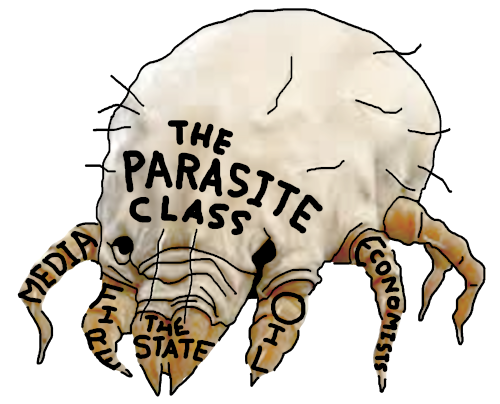
Let’s turn to the second question: is the picture of self-serving decision-making sketched above actually true? In reality, people aren’t perfectly rational and perfectly informed, of course, and as the research of C. Daniel Batson and others has shown, humans aren’t just selfish either and other motivations may be stronger than egoistic motivations.7 However, as already noted above, the second question isn’t really about you and me – the question is whether the picture is true (or true enough) for those in power (i.e., the parasite class and its loyal servants), and for at least three reasons, the answer to that question is “yes”.
- The ideological worldview of the rich and of centrist and right-wing politicians is heavily influenced by mainstream/neo-classical economics and its image of man, often called homo economicus, as a perfectly selfish or psychopathic creature. There is evidence that the stronger people are influenced by this ideology, the truer it becomes for them, or in other words, the more selfish/psychopathic they become.8
- There is a lot of evidence that the rich refuse to empathize with people outside their social circle/class (i.e., members of the middle class, the poor, etc.) and could (or should), therefore, be considered a kind of psychopaths-by-choice.9
- Rather unsurprisingly, perhaps, there is also evidence that politicians score high in narcissism, which is closely related to psychopathy, sharing its here relevant features.10
Homo economicus makes its decision based on CBA, but the only costs and benefits that matter in the calculation are costs and benefits for the individual decision maker. Homo economicus is entirely motivated by self-interest, and the same is true for psychopaths and narcissists. If and when social costs and benefits matter, those only matter indirectly – for example, because giving the appearance of caring about social costs and benefits serves the decision-maker’s self-interest. Under the influence of this ideology, and leaning towards psychopathy and/or narcissism moreover, the rich and their henchmen (such as centrist/right-wing politicians, mainstream economists, much of the mainstream press, the financial sector, and so forth) act much like homines economici – their decisions are entirely motivated by self-interest. There is (at least) one fundamental difference between homines economici and the parasites that rule us, however – while the former are perfectly informed, the latter are not. And consequently, the self-interested CBA that guides their decisions is based on perceived costs and benefits, and not necessarily on actual costs and benefits.
So, to repeat, it is the individual/private costs and benefits of the people who make the relevant decisions that matter. And this explains perfectly why so little is being done to address climate change, as well as why climate activism has so little effect. The reason why climate policy is lagging far behind what is needed is that for the parasite class and their henchmen, the costs of climate policy are considerable,11 while the benefits are negligible; and moreover, the perceived costs of climate change are insignificant, especially in comparison to the costs of climate policy. There are several reasons why the latter is the case. Most obviously, the worst effects are far enough in the future to be of relatively little concern to the generations that make most decisions now. Moreover, the rich tend to believe that they can sufficiently insulate themselves from the worst effects of climate change (through technological and financial means) to be not significantly affected by it. Some of the members of the parasite class might even consider some effects of climate change a benefit rather than a cost, as the people who are likely to be worst affected are disposable in their eyes anyway. In that view, climate change is going to get rid of some “dead wood” (and “thanks” to AI, this “dead wood” includes an ever-increasing number of us – as I argued before, the parasite class is waging a war against humanity).12
So in short, nothing much is being done about climate change, because the costs of doing anything far outweigh the benefits, at least for the people who decide whether and what should be done. It should also be quite obvious now why most climate activism is quite ineffective: climate activism does not (or not sufficiently) increase the costs of inaction (in the sense of refraining from implementing effective climate policy). Furthermore, in as far as climate activism does incur costs, it is easier and cheaper to respond to these costs by criminalizing and punishing or killing climate activists than by addressing climate change. (By the way, it should be rather obvious that there are no legal means to force the parasite class to consent to effective climate policy either, as they are effectively in control and will never allow implementation of policies with a significantly negative cost/benefit balance to them.)
The only way climate activism could be effective (in the sense that it results in the implementation of effective climate policy) is if the costs incurred by that activism cannot really be avoided and are greater than the costs of climate policy. Traditional activism cannot possibly achieve this (and neither are there legal means to do so, for reasons already mentioned), partially because the costs it incurs are far too small, partially because those costs are too easily avoided or neutralized. It needs to be kept in mind that the costs incurred must be personal costs for those in control, as it are individual/private costs and benefits that matter.
What, then, could hypothetically work? What could possibly incur private/personal costs that outweigh the private/personal costs of effective climate policy? It seems to me that the only cost that would be high enough – taking the wealth and power of the people involved in consideration! – is the threat of assassination. Hypothetically, that could work, but in practice it is quite impossible. It is not impossible to assassinate a few of the members of the parasite class, of course, (even if it would be hard to pull off) but even if as much as 1% of the parasite class would be assassinated, the perceived assassination risk would be much too low to counterbalance the cost of climate policy (thereby shifting the CBA), especially considering that it would be cheaper and easier to force the government to spend tax money on more security for the parasite class and more persecution of their enemies to address the threat. And increasing the perceived assassination risk sufficiently to shift the CBA such that implementing climate policy becomes the more attractive option for the parasite class is virtually impossible in the current situation. It could only succeed if the parasite class can no longer rely on protection by the state and its armed forces (including the police). Or in other words, it could only succeed if enough of the armed forces in the war against humanity switch sides (i.e., from against to for/with humanity) . Due to the effectiveness of the propaganda spread by the parasite class (who own most of the mass media) this is very unlikely to happen, however, although it is hard to make predictions for the slightly more distant future.13
To be clear, my point here is to argue that Cost-Benefit Analysis (CBA) clarifies why so little is done to combat climate change, and why climate activism is so ineffective (and more likely results in criminalization and persecution than in the desired effects). While I would shed no tears over the violent death of any member of the parasite class, there are ethical issues involved that I haven’t addressed here.14
If you found this article and/or other articles in this blog useful or valuable, please consider making a small financial contribution to support this blog, 𝐹=𝑚𝑎, and its author. You can find 𝐹=𝑚𝑎’s Patreon page here.
Notes
- David Schmidtz (2001), “A Place for Cost-Benefit Analysis”, Philosophical Issues 11: 148–71.
- Jeppe von Platz (2025), “Climate Change and Cost-Benefit Analysis: A Dilemma”, Ethics, Policy & Environment: DOI: 10.1080/21550085.2025.2574213.
- See, for example: The War Against Humanity; and: Lajos Brons (2017), The Hegemony of Psychopathy (Santa Barbara: Brainstorm).
- “FIRE” stands for Finance, Insurance, and Real Estate.
- On the parasite class, see: The War Against Humanity. On the TCC, see: Leslie Sklair (2000), The Transnational Capitalist Class (New York: Wiley); and: William Robinson (2014), Global Capitalism and the Crisis of Humanity, New Edition (Cambridge: Cambridge University Press). On FIRE, see: Rent, Debt, and Power; and: Michael Hudson (2015), Killing the Host: How Financial Parasites and Debt Bondage Destroy the Global Economy (Petrolia: Counterpunch Books). See also: Peter Phillips (2018), Giants: The Global Power Elite (New York: Seven Stories).
- This is explained in much more detail in Enemies of Our Children.
- e.g., C. Daniel Batson (2011), Altruism in Humans (Oxford: Oxford University Press). Batson (2016), What’s Wrong with Morality? A Social-Psychological Perspective (Oxford: Oxford University Press).
- Fabrizio Ferraro,Jeffrey Pfeffer, & Robert I. Sutton (2005), “Economics Language and Assumptions: How Theories can Become Self-Fulfilling”, Academy of Management Review 30.1: 8–24. See also: Brons , The Hegemony of Psychopathy.
- e.g., Jennifer Stellar, Vida Manzo, Michael Kraus, & Dacher Keltner (2012), “Class and Compassion: Socioeconomic Factors Predict Responses to Suffering”, Emotion 12.3: 449–59. Michael Kraus, Paul Piff, Rodolfo Mendoza-Denton, Michelle Rheinschmidt, & Dacher Keltner (2012), “Social Class, Solipsism, and Contextualism: How the Rich are Different from the Poor”, Psychological Review 119.3: 546–72. Paul Piff (2014), “Wealth and the Inflated Self: Class, Entitlement, and Narcissism”, Personality and Social Psychology Bulletin 40.1: 34–43. David Dubois, Derek Rucker, & Adam Galinsky (2015), “Social Class, Power, and Selfishness: When and Why Upper and Lower Class Individuals Behave Unethically”, Journal of Personality and Social Psychology 108.3: 436–49.
- e.g., Robert Hill & Gregory Yousey (1998), “Adaptive and Maladaptive Narcissism among University Faculty, Clergy, Politicians, and Librarians”, Current Psychology 17.2: 163–69.
- The costs of effective climate policy should not be underestimated and those costs may not just be prohibitive for the parasite class. For more on this topic, see for example: The Lesser Dystopia.
- On the topic of “disposables” or “dead wood”, see also: You are a Zombie.
- In regard to this “slightly more distant future” it is an interesting question what the effects of rising food prices and the cost of living are going to be. It is an open question whether (and at what point) rising poverty and insecurity will be able to break through the deceptions and propaganda spread by the parasite class.
- For a discussion of some of those ethical issues, see: The Ethics of Climate Insurgency.